HydraSolver
Built for the next generation.
Solve Pot-Limit Omaha through six cards, hi-lo, No-Limit and Limit Hold’em, Short Deck, double board bomb pots and private-game variants. Solve tournaments with ICM, progressive knockouts and mystery bounties. Then read the result in a browser, free.
Both applications are in English. This page is not — it is here so you can read what they do in your own language before you spend anything.
Two products
Which one do I want?
One of them solves poker. The other reads a solve that is already finished. Most people should start with the second, and it costs nothing.
HydraViewer
free
Reads a solved spot in your browser. No install, no licence, nothing to configure. Every file is opened on your own computer and never uploaded. Start here.
HydraSolver
US$850 a year
The desktop solver. Build any tree you like on your own sizings and solve it — every node, every EV, pausable and resumable, and yours to keep.
Both together
the usual way
Solve on the desktop, export a .hdv, and read it in the browser on a laptop or a phone away from the machine that solved it.
What it solves
All the games, one engine
One tree builder, one strategy browser, one trainer — every one of them adapts to the variant you are working on. Add a card, a player, a bounty or a second board and the same shell gives you the right combinatorics.
- Pot Limit Omaha
- 6-card PLO
- 5-card PLO
- Big O
- PLO 8
- Omaha 8 or Better
- NL Hold’em
- Limit Hold’em
- Limit Omaha
- Short Deck
- ICM
- Bounty Hunter
- Mystery Bounty
- Bomb Pot
- Double Board
- Squid Game
Two to nine seats, including multiway postflop. Omaha runs four, five and six cards high, and four and five cards hi-lo eight-or-better.
Tournament equity
Chip EV is not money EV
A double-up is not worth twice as much when there is a pay jump underneath you. The solver knows the difference, and it is the same engine either way.
- ICM with future game Switch from chip EV to ICM and payouts, players left, stacks and future game all feed the algorithm, so a stack is valued in real money rather than in chips.
- Bubble factors and risk premiums, on the spot Visible where you are reading, so you can see how ICM reshapes each decision rather than only the headline EV.
- Progressive and fixed knockouts Fair, Total T$ and Disbursed P$ options for PKO, plus fixed knockout. The bounty and the payout structure are inputs to the solve, not a number added afterwards.
- Mystery bounty, valued honestly Priced at the mean of the envelopes still in the pool — a mean EV rather than a sampled draw — with envelopes left and chips-per-dollar kept in the model.
- Large fields, not only final tables Accuracy stays stable when the field is big, so a day-two spot is as solvable as a nine-handed final.
Tree builder
Build the spot you actually play
Positions, stacks, antes and bet sizings, street by street — then press Size and find out what it will cost in memory before you start rather than after.
-
Write a sizing rule once, apply it to the whole tree
A real language rather than a grid of boxes:
RFI,3BETISO,FLOP.CBET.3BP, sizes like3x+1bb. Save rules as presets, nest presets inside each other, and apply preflop through river in one action. Two rules of equal specificity landing on one spot is a conflict, and the apply refuses rather than picking one. -
Seats have names, so one config fits every table
Rules accept
player=BTN,vs=COandalive=SBas well as indices, resolved against the table the rule is matched on — so the same config is correct at six-max and at nine-max. -
A memory estimate before you commit
Size reports decision counts, strategy-store RAM and the approximate
.hdrand.hdvsizes the run will produce. - Postflop solves out of a preflop solve Stop on any node of a solved preflop tree and promote it to a new root. Ranges, pot, stacks and node locks come with the node — no export and no retyping — and folded seats keep their mucked ranges so bunching stays right.
- Boards by texture, or all 1,755 of them The current board, a pasted list, every canonical flop, texture chips, weighted boards or a named subset. Turn and river run full boards too. Queue the batch and leave it.
-
Ranges from whatever tool you already use
.p4rg, PPT, Pio, CSV, GTO+ blocks and Hold’em shorthand, pasted or dropped in. Percentile ranges liketop10%and expressions like$dsare understood directly.
Solving
Solve on your terms, on the machines you have
Stop when you say stop. Pause, resume and re-solve at any point, and read what the accuracy actually is while it runs.
- Split one batch across several machines Point a second computer at the same shared folder and press Join batch — the boards are handed out from one manifest, and the results land together. A desktop and a laptop finish a texture set in a little over half the time.
- Stop on exploitability, drift, convergence or time Set per solve, so every board in a batch finishes on its own criteria instead of on the slowest one.
- Accuracy you can read while it runs Exploitability as the headline number, with convergence and volatility beside it, plus a certificate and a best-response probe. When the abstraction is coarse or the maps are legacy, a banner says so rather than letting a clean-looking number stand.
- The cores you choose, and a memory ceiling Pick the worker count, or run single-worker when two solves have to match exactly. Cap the solve at a share of system memory so the machine stays usable while it works.
- Reset regret and reset strategies, separately Two tools for two jobs: clear the learning without wiping the strategy, or start the strategy over. After a node lock, the second is much the faster way back.
- A headless runner for the long ones Run and resume a batch without the interface, so a big set can go overnight on a server that has no screen attached.
Reading the result
Read the strategy properly
Frequencies and EV for every hand, in a grid built for the game you solved — not a screenshot of somebody else’s.
- The right chart for the game 13×13 for Hold’em, 9×9 for Short Deck, hand class against suitedness for Omaha with row and column marginals. Click a cell to filter and drop into the hand list.
-
A filter language, not a search box
$ds,AA, suits and connectivity. Group or expand combos, sort on any column, switch between chips and big blinds. - Blockers are carried, not inferred The readout brings them with it, so you are not working them out from the board yourself.
- What the second-best action costs EV delta against the best action at the node, so a close decision reads as close and an expensive one reads as expensive.
- What the folds took with them A bunching panel for the range that already left the pot — without it the live ranges do not add up.
- Cleaned and exact, side by side Cleaning a strategy for reading has a price, and the app shows you the price rather than hiding the exact numbers underneath it. Export any chart as a PNG.
- Bookmarks, history and notes Mark the spots that matter, step back through where you have been, and leave notes on a solve or on a single node.
Node locks and best response
Lock a strategy, then attack it
Equilibrium is the start of the question, not the end of it. What beats the way your game actually plays is a different solve.
- Pin the frequencies you want and free the rest Lock how a seat plays at a node and the solver works around it. Locks are inventoried, and you can release them one at a time when you change your mind.
- Best response against a locked table Pick a seat and the solver attacks every other strategy at the table. You get that solve’s leaks ranked biggest first, each row clickable straight to the spot that leaks.
Trainer
Deal the spot and get graded
In both products, and graded the same way in both: by what your answer cost, not by whether it matched the most frequent action.
- Graded by EV loss, in five tiers Best through blunder, the way an engine grades a chess move — so taking one arm of a 51/49 mix is not marked wrong.
- Roll the mix Sample the solved frequencies so you practise a mixed strategy deliberately rather than always taking the majority action.
- Where the money actually went The session cut several ways and ranked by total lost rather than by average, so the leak that costs most is at the top even if each instance is small.
- Drill exactly the decision in front of you In the viewer, pin the spot you are reading and it deals that decision across every board in your library — with the count shown before you commit to it.
- Misses come back Spaced repetition counted in answers rather than in days, so the queue still means the same thing after a fortnight away.
- How long you took to decide Median think time beside the accuracy. Hesitation is a signal accuracy on its own cannot give you.
Saving and exporting
Take it with you
Nothing you solve is trapped in the application, and nothing about a save depends on us still being here.
-
Resumable
.hdrsaves Reopen a solve and keep calculating from where it stopped, or open a browse snapshot scoped to the street you solved. -
Export to the browser
Write a
.hdvand open it in HydraViewer with nothing installed. Lite exports, EVs and cleaned paths are all options when you need them. -
Formats other tools read
PPT
.txt, columnar JSON, CSV, Pio format and range export and import. One street or the whole tree. -
A batch comes back as files
A board batch saves as
.hydrasimalongside a frequency-weightedaggregate.csvwith texture rows included. - Projects, recent trees and recovery A project manifest ties a tree to its assets with checksums, recent trees are one click away, and an interrupted session offers to restore itself.
Measured, not claimed
6-max No-Limit Hold’em, 100bb, 32 cores
The same tree, the same bet sizings, comparable balanced abstraction and the same accuracy target on the same machine, against MonkerSolver.
Wall-clock to the same exploitability target on identical hardware; peak resident memory sampled once a second across the whole run.
HydraViewer
Free, in your browser, and nothing is uploaded
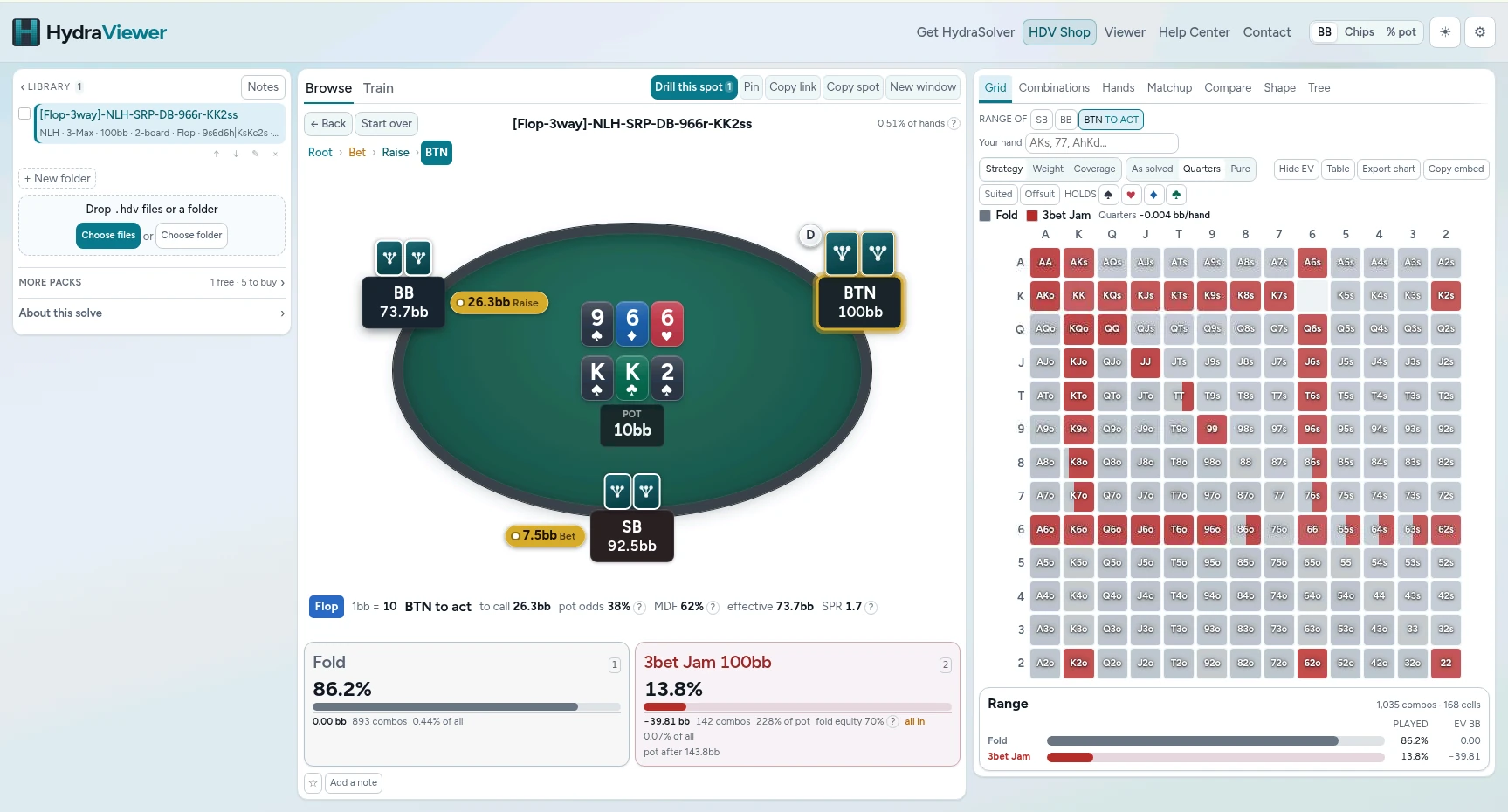
HydraViewer reads solved spots. There is nothing to install and nothing to buy before you can use it — open the site and drop a file on it.
- Nothing you open ever leaves the device Solves are read in the browser on your own computer. There is no server to send a strategy to, and no account to make.
- Ten-gigabyte files open without being loaded A real solve is far too big to hold in a browser tab, so it is read in byte ranges and never held whole.
- Works offline once it has loaded Installable, and the shell, your library and your local files all open with the connection cut. Only the shop needs the network.
- Your library survives the tab closing The shelf, your place in each bundle, your session and your notes all come back — held in your browser, never uploaded.
- A hundred solves sort themselves into games Each bundle states the game it was solved for, so an import lands as a drawer per game with each flop under its own preflop solve.
- Untrained means untrained, never 0% A bucket the solver never visited is hatched rather than shown as zero, because a confident zero would claim it chose not to act.
- Every board in a pack, folded into one report The mean across boards with the spread behind it — a 60% mean built from 20% and 100% is two strategies, and the mean alone cannot tell them apart.
- It prices the decision beside the solution What a bet needs to win as a bluff, what a call needs, and minimum defence against the frequency the solve actually folds.
- Check your own chart against the solve Import a range from another tool and see exactly where it disagrees, priced in EV.
- Publish a chart on your own page A read-only grid you can embed anywhere, carrying its data in the link itself — so your readers fetch nothing from us and we learn nothing about them.
- Readable without seeing it One tab stop, arrow keys through the grid, every cell announcing its full mix, and the same numbers as a plain table on request. A colourblind-safe palette that still composes with dark mode.
Free packs to start with, and paid packs from $19 to $89. Five packs take 10% off, ten take 20%, twenty take 30%.
What it needs
Before you buy the solver
Two numbers matter: how much memory you have, and how much free disk. Memory decides what you can solve — more players, deeper stacks and more hole cards each cost memory. Cores only decide how fast it finishes.
Memory
64 GB minimum
256 GB+ recommended
64 GB runs Hold’em and smaller Omaha trees. Serious multiway PLO and deep tournament work wants 256 GB, or a rented server.
Disk space
300 GB free, to install and run
- Application and abstraction maps ~220 GB
- Working room while solving ~80 GB
- Saved solves, which are yours to keep on top
A finished .hdr is often 1–20 GB depending on the tree. Leave room for the ones you want to keep.
Windows and Linux. HydraViewer needs only a current browser, and runs on a phone.
Licence
One price, no tiers
US$850 per year, two machines
- Two activations — a desktop and a laptop, or you and a partner.
- Every game it supports. Nothing is held back for a higher tier.
- Every abstraction set, and all updates released during the year.
- Works offline. It contacts the server to renew, not to run.
- Move a machine whenever you like — release a seat from Settings, and a seat left idle for 120 days frees itself.
- Pay by card or with Bitcoin. Same licence either way.
Charged in US dollars, so your bank converts at its own rate. There is no free trial: if you want to see solved spots before paying, HydraViewer is free and needs no licence.
What happens when the year ends
When the year ends the solver goes read-only rather than dark. You can still open, browse, train on and export everything you have already solved — you simply cannot start a new solve until you renew, and renewing adds a year to whatever time is left rather than starting the clock again.
Questions
Before you buy
Is the software available in my language?
No. HydraSolver and HydraViewer are both in English, and this page is the only part that is translated. We would rather tell you here than have you find out after paying. HydraViewer is free, so the honest way to judge it is to open it and see how much of it you can follow before you spend anything.
Can I pay in my own currency?
The price is set and charged in US dollars and your bank converts at its own rate. Card payments go through Stripe; Bitcoin is accepted on-chain with the rate fixed when the invoice is issued.
What does US$850 cover?
One year of HydraSolver on two machines: every game it supports, every abstraction set, and all updates released during that year. There are no feature tiers and nothing sold separately.
Is there a free trial?
No. If you want to look at solved spots without paying, use a free HydraViewer pack in your browser.
What happens when the year runs out?
The solver becomes read-only. You can still open, browse, train and export your existing solves; you cannot start a new one until you renew. Nothing you already paid for stops working.
Can I move it to another computer?
Yes. Each licence has two activations, and you can release one from Settings → Licence when you change machines. A seat that sits idle for 120 days frees itself.
Does it need to be online?
No. HydraSolver works offline for as long as your licence is valid — it contacts the server to renew, not to run.
Do my files leave my machine when I use HydraViewer?
No. Every file is opened and read in your browser on your own computer. There is no server to send it to.
What hardware do I need?
64 GB of memory at a minimum, and 256 GB or more if you are serious about multiway Omaha or deep tournament trees, plus about 300 GB of free disk to install and run. Saved solves need room on top of that. HydraViewer needs none of this — it runs in a browser.
Can I use more than one computer on a single solve?
Yes, for a board batch. Point the machines at one shared folder and each takes boards from the same manifest, so a texture set finishes in a fraction of the time. A single solve still runs on one machine.
How was the benchmark measured?
Both solvers ran the same 6-max 100bb tree with the same bet sizings and comparable balanced abstraction on the same 32-core machine, each until it reached 0.30% of pot exploitability. Peak memory was sampled once a second across the whole run.
Read one first. Solve one when you are ready.
HydraViewer costs nothing and opens in the browser you already have. HydraSolver is there for when you want to solve the spot yourself.